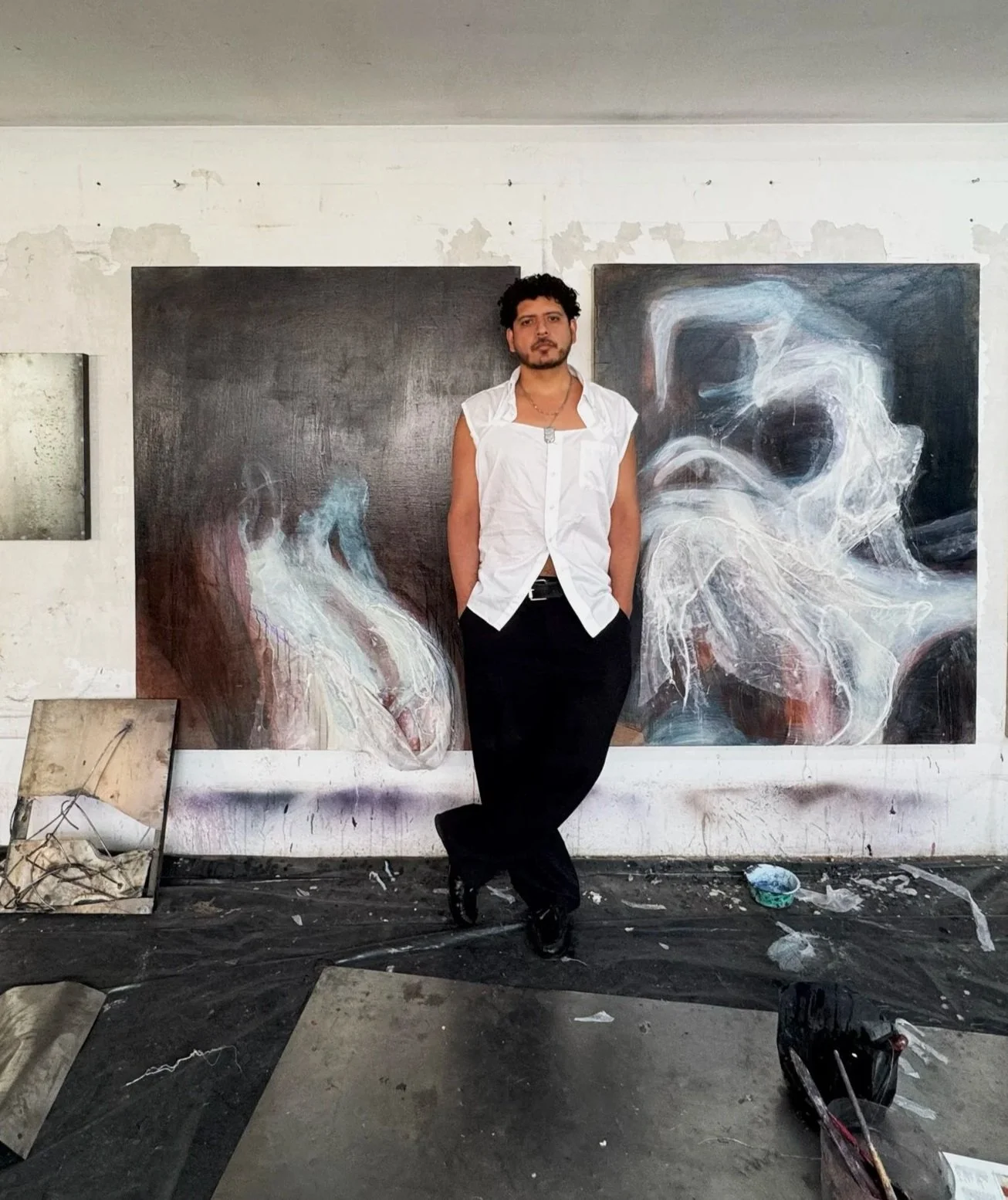
Rodrigo Ramírez Rodríguez
Rodrigo Ramírez Rodríguez is an artist and researcher based in Mexico City whose practice spans sculpture, painting, installation, and expanded cinema. His work approaches artistic practice as the creation of experiential conditions rather than the production of discrete forms. Through processes of transformation, contamination, and accumulation, his installations bring materials, images, light, and architectural space into configurations that resist stable identities. Within these environments, images emerge as material events, and perception becomes inseparable from the relations through which the work takes form.
At the center of his practice is an investigation into how categories and boundaries are produced, destabilized, and transformed through material encounters. Distinctions between subject and object, surface and depth, representation and sensation, and human and nonhuman are approached not as fixed oppositions, but as configurations that become unstable through processes of decomposition and mutual affectation. His work explores how materials, images, forces, and temporalities participate in the formation of worlds without being reducible to a single organizing subject.
This inquiry has led him to develop the concept of the sensitive surface: a field of material composition in which forms, images, differences, and capacities emerge through processes of transformation and individuation. Rather than understanding the surface as a boundary separating an interior from an exterior, he approaches it as a site of relational emergence. The concept provides a framework for investigating how artistic configurations generate relations and modes of existence that exceed the centrality of human perception.
His research brings Deleuze and Guattari’s concepts of immanence and assemblage into dialogue with Gilbert Simondon’s theory of individuation and Karen Barad’s account of intra-action. It also engages with object-oriented ontology, Amerindian perspectivism, and Latin American neobaroque thought to examine the relations between material entities, their environments, and the processes through which they become differentiated. Within this framework, he is developing the provisional concept of a cannibalism of objects: a way of thinking about how entities incorporate, affect, and transform one another, unsettling the boundaries that distinguish them. This inquiry approaches anthropophagy not only as an aesthetic strategy, but also as a problem of material transformation, relationality, and the production of difference.
Ramírez’s artistic and theoretical research is informed by a sustained engagement with moving images and documentary cinema. He is currently completing a PhD in Documentary Film at the National Autonomous University of Mexico (UNAM), where his research examines posthuman approaches to documentary through the philosophies of Deleuze, Spinoza, and Leibniz, with particular attention to immanence, the powers of the false, and the neobaroque. His current work extends these questions toward material assemblages, nonhuman modes of existence, and the conditions through which images and forms emerge.
Alongside his artistic practice, Ramírez has developed a pedagogical practice spanning community-based art education, workshop facilitation, and university teaching. Through his work with the FAROs cultural centers in Mexico City, he has facilitated artistic workshops and participated in the training of workshop educators. His pedagogical interests focus on transversal approaches to learning, collective knowledge production, and experimental forms of aesthetic inquiry. He is particularly interested in how artistic and educational environments can become sites for composing relations among different disciplines, materials, and forms of knowledge.
His broader research connects artistic experimentation with philosophical inquiry, ecological questions, and decolonial approaches to the production of knowledge. He is interested in how sculpture, installation, expanded cinema, and emerging technologies—including artificial intelligence—might open experimental sites for investigating material relations beyond the human, while attending to the political and ecological conditions that shape them. Across his work, art becomes a way of investigating how worlds are composed, how entities transform one another, and how new forms of perception and existence become possible.