Rodrigo Ramírez Rodríguez | RESEARCH
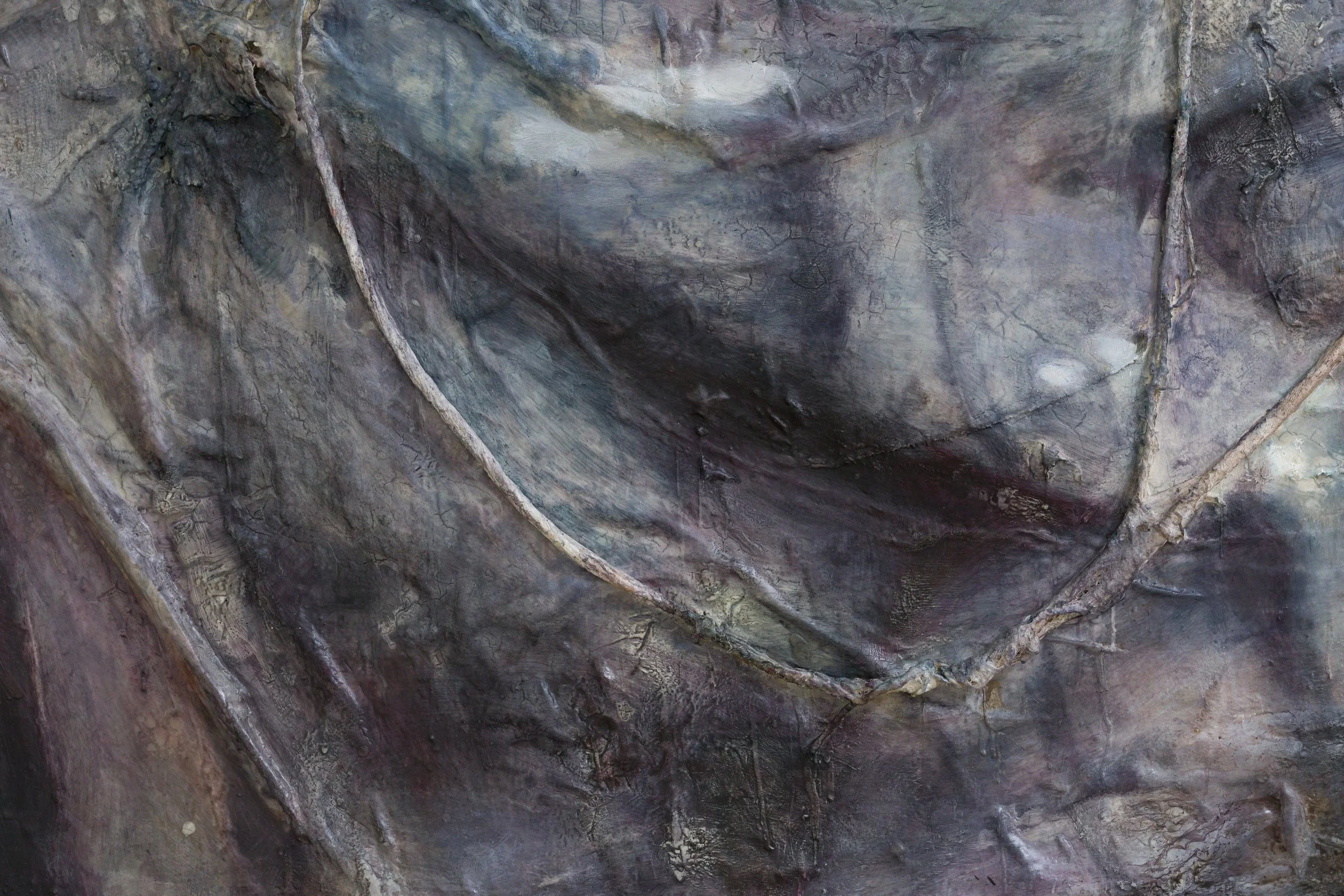
Rodrigo Ramírez Rodríguez’s research investigates how forms, images, and modes of existence emerge through processes of material composition, transformation, and individuation. Operating between sculpture, painting, installation, and expanded cinema, his artistic practice approaches art as the creation of experiential conditions rather than the production of discrete forms. Through processes of transformation, contamination, and accumulation, his works establish material configurations in which identities remain unstable, images emerge as material events, and perception becomes inseparable from the relations that produce it.
The research approaches artistic practice as a site for investigating the ontological conditions of emergence: how entities take form, how material configurations generate capacities and differences, and how relations transform what they bring into existence. Rather than beginning with an autonomous human subject confronting an external world, it examines the heterogeneous assemblages through which subjects, objects, images, and environments are differentiated and continually reconfigured.
I. THE SENSITIVE SURFACE
Thesis
The sensitive surface is a field of material composition and differentiation in which images, forms, and capacities emerge through processes of transformation and individuation.
Artistic practice is approached as the composition of heterogeneous assemblages whose elements do not simply occupy a shared space but participate in one another’s transformation. Materials, images, forces, technologies, and temporalities contribute to configurations that exceed the identity or function of their constituent elements.
Matter is understood not as passive substrate but through its capacities, resistances, and modes of becoming. Forms and entities emerge through processes of individuation that remain open to further transformation, challenging fixed distinctions between object and environment, surface and depth, and human and nonhuman.
Drawing on Deleuze and Guattari’s concepts of immanence and assemblage, Gilbert Simondon’s theory of individuation, and Karen Barad’s account of intra-action, the research develops the concept of the sensitive surface to investigate the material processes through which forms, differences, and capacities emerge. In dialogue with object-oriented ontology, Amerindian perspectivism and its cannibalistic dimension, and Latin American neobaroque thought, it explores how these processes challenge established divisions between entities, relations, and modes of existence.
The project further develops the provisional concept of a cannibalism of objects: a way of thinking about material encounters through which entities incorporate, affect, and transform one another, while the boundaries and identities that distinguish them are themselves altered. Through sculpture, installation, and expanded cinema, this inquiry investigates the aesthetic, ecological, and decolonial implications of material relations beyond the human, including the possibilities and tensions of artistic experimentation with artificial intelligence.
Areas of Research
Posthuman ontology and material processes
The sensitive surface and material composition
Assemblages, immanence, and relational configurations
Individuation and preindividual fields
Material agency, capacities, and transformation
Deleuze and Guattari, Gilbert Simondon, and Karen Barad
Object-oriented ontology and Amerindian perspectivism
Anthropophagy and Latin American neobaroque thought
Sculpture, installation, and expanded cinema
Images as material events
Nonhuman modes of existence and ecological relations
Artistic experimentation and artificial intelligence
Our Work: Collective Practices
Ramírez’s practice extends beyond the production of individual artworks into collaborative and collective modes of making. Through shared projects, artistic production becomes a process shaped by encounters among different practices, materials, forms of knowledge, and working conditions.
These collaborations open questions about authorship, agency, and the organization of artistic work. Rather than treating collectivity as the sum of individual contributions, they offer ways to investigate how forms emerge through shared processes and how the conditions of production shape what can be created.
CRÁNEO |
Our Work: Pedagogy & Transversality
Ramírez’s pedagogical practice encompasses community-based art education, workshop facilitation, and university teaching. Through his work with the FAROs cultural centers in Mexico City, he has facilitated artistic workshops and participated in the training of workshop educators.
His approach to pedagogy explores how artistic knowledge can emerge through experimentation, exchange, and the crossing of disciplinary boundaries. Drawing on transversal approaches to education, this work considers learning as a process shaped by heterogeneous forms of knowledge, collective inquiry, and situated experience.
His ongoing pedagogical research investigates the possibilities of a laboratory for aesthetic experimentation, connecting expanded cinema, painting, sensory experience, and collective artistic practice. It approaches the learning environment not as a neutral container for knowledge, but as a configuration whose relations can generate new modes of perception and creation.
Our Work: Writing & Research
Ramírez’s writing and research investigate the philosophical conditions of artistic creation, with particular attention to immanence, materiality, individuation, and posthuman thought. His doctoral research in Documentary Film at the National Autonomous University of Mexico (UNAM) examines posthuman approaches to documentary cinema through Deleuze, Spinoza, Leibniz, and Latin American neobaroque thought.
His current research develops the concept of the sensitive surface to investigate how forms, images, and capacities emerge through material relations and processes of individuation. In dialogue with Deleuze and Guattari, Gilbert Simondon, Karen Barad, object-oriented ontology, and Amerindian perspectivism, the project explores what he provisionally calls a cannibalism of objects: a way of thinking about how entities incorporate, affect, and transform one another.
His philosophical research also informs his engagement with The New Centre for Research & Practice, where he was offered a scholarship for the Certificate in Critical Philosophy. Across artistic practice and theoretical writing, these inquiries explore how material configurations and relational processes might challenge established distinctions between human and nonhuman, subject and object, and representation and sensation.